Chasing Happiness Finding Joy

The Harvard Study of Adult Development is the most comprehensive study about happiness ever conducted. Begun in 1938 and following successive generations, this study has followed family units for eight generations.

The study correlated factors related to well-being and happiness. The study found that the most important factors are taking care of health and building loving relationships. According to an article in Medscape, good health is essential to live well. Researchers also determined that meaningful relationships were the most significant predictor of health and happiness during aging.

I beg to differ with the Harvard Study, on the issue of happiness. I am a big fan of happiness, but it is pretty fickle. Happiness comes and goes based on external factors, sometimes beyond the control of the individual.  Health is not a de-facto determination of happiness. From my own experience with sudden and radical changes in health, I can honestly say some of the richest times of my life have unfolded in the ensuing years as I learn to live with chronic illness. That’s not to say it hasn’t sucked a good part of the time, but that’s not the whole story.

Having meaningful relationships is an indicator of life satisfaction. On this point I agree with the Harvard Study. I think we are lucky if we have two or three close companions in our lives. I am blessed to have to take off my shoes to count the people I count on. I am inclined to take off my shoes anyway, because whenever we are together we walk on sacred and storied ground.

There have been a few surprises along the way. Sometimes people I expected to be companions with me through the changes in my life were suddenly in the wind. On the other hand, those I never dreamed would be of support through the ups and downs of my health have been my closest companions. Not everyone can show up for sick duty.

Going a step beyond the Harvard study and its focus on health and good relationships, there is joy. It is made of much stronger stuff than happiness and is not dependent on emotions or the outer circumstances of life. Joy is a state of deep contentment that can exist even in the face of profound sadness, illness and death.

I learned again and again from my hospice patients and their families that joy resides in the deepest place of love. And even when life was ebbing to a close, there could be moments of deep joy and contentment. A life spent together, the sacredness of the dying process, the promise of suffering coming to an end and comfort until that moment unfolds. It is not a rowdy kind of joy but a quiet inner sense that all shall be well, even when it seems everything is falling apart.

Joy is not something we can will. We cannot grit our teeth when life sucks and say, “Well, I’m going to find joy now.” Joy is something that taps us on the shoulder and enfolds us in its soft embrace. It doesn’t come crashing in like a brass band. Rather it comes in on a whisper, a gentle breeze that reminds us that life is still happening around us. Joy can surprise us when a cardinal lights on a branch outside the window and sits there in all its brilliant red glory. Joy wears a million faces. Moments of joy gently invite us but never push their way into our life. It is always there, always ready for us, even when we aren’t ready for it.

Joy may not move in and set up shop for long periods of time. Rather comes in moments that are ours for the receiving when we are ready and tuned in.

Joy is not a short cut through pain. It is not a detour around pain.  As my therapist used to tell me; “The only way out is through.” We have to find our own way, in our own time, in our own process. Along the way we can discover moments of joy. Authentic joy can exist side by side with pain, illness, sickness, death, sadness and the panoply of human emotion and experience.

As Psalm 30 verse 5 reminds us, “Weeping may last for a night, but joy comes with the morning.”

The Voice of the Common Good, Integrity and Justice

An Open Letter to Associate Justices

Sotomayor, Jackson Brown and Kagan

Thank you for keeping the mandate of your office in the face of seemingly impossible odds. You may represent the minority on the Court, but you speak for most Americans. I, for one, cheer you on every time you write a brilliantly dissenting opinion.

As the highest Court in the land continues to squander its integrity, credibility and humanity, you are the voices that keep these crucial qualities alive. Thank you. A thousand times, thank you. Facing daunting odds you continue to keep the common good at the fore and the demands of justice as your mandate.

You maintain clarity about your role in the larger government system and take seriously your part in keeping the rule of law. You mete out rulings that benefit the greatest number of people and protect vulnerable populations. Your rulings challenge us to think beyond our own short sighted self-interest and keep our eye focused on what is best for the people of our nation. It is a heavy task in these days of shrinking vision, prejudice, bigotry and hatred. Thank you for being the voice that counters these voices in the Court.

I have no doubt that yours is a heavy mantle in these days. Know that there are many who may never write to you, but strongly support your work, perspective and commitment to the integrity of the court.

I look forward to the day when balance is restored to the court and it regains the integrity you so boldly embody. Until that day, thank you for holding the line and living out the courage of your convictions as individuals. Thank you for being legal scholars who value the Constitution and the Bill of Rights as the guiding documents for the rule of law in this land. We are counting on you to keep on keeping on, even in the face of seemingly insurmountable odds.

With Gratitude and Appreciation

Rev. Patricia L. Liberty

Theirreverentreverend.blog

This letter was sent to each of the above named Justices. Please feel free to copy and use this letter for your own correspondence as a word of encouragement. Please give authorship and include the blog address as listed above.

It is a Sad Day

An Open Letter to Chief Justice Roberts and Associate Justices

Gorsuch, Barrett, Kavanaugh, Alito and Thomas

It is a sad day for the United States. It is also a sad day for the Supreme Court. As the keepers of the highest court in the land you continue to betray your mandate, pander to hate groups and set back civil rights for LGBTQ+ Americans and all people of color.

You collectively form a power block in the court that you are using to undermine the principles of freedom and the right to self-determination. Your decisions are making it legal to deny healthcare based on “religious conviction,” increase institutional racism and deny fundamental rights of women to make decisions over their own bodies.

It is disgusting to me that several of you lied or dodged the question about Roe v. Wade and there are no consequences to you for your lies. Your mouths are filled with double speak and you fail to speak the truth and protect the rights of all people.

It is disgusting to me that your individual integrity is utterly absent in your duplicitous actions that make you beholden to the wealthy and powerful. It nauseates me to know we have elected a rapist to the highest Court in the land just because you shed a few tears and boo-hooed to the cameras. Most of us were not fooled by your Oscar worthy acting.

There is not enough space in this document to point out the individual moral failings of each of you, but there is enough evidence to underscore the voids in your individual moral consciences and see the way that plays out in your legal decisions. Again, it is disgusting and nauseating.   

Since you, Chief Justice Roberts assumed his position on the court there has been a distinct shift toward protecting businesses and corporations rather than listening to individuals who seek redress in the court. Siding with business and corporations to selectively deny rights of patrons, while protecting workers who fit your political agenda, is despicable.

Your alliance with Opus Dei clearly shows the fascist tendencies of the Court. You are becoming the handmaiden that hides behind the “rule of law” to push forward an agenda that is radically conservative and socially backward. You would do well to take to heart the words of Matthew Fox, “The Supreme Court itself has become a cesspool of religious ideology ignoring the pluralism of American culture in favor of a far right version of evangelical and Roman Catholic Christianity committed to anti-abortion fanaticism.” A cesspool is an accurate assessment of your presence on the Court.

You are squandering your credibility and have already squandered your integrity. You fail to remedy injustices of the past through your current decisions, such as affirmative action. You fail to understand the institutional, cultural and systematic racism that permeates our social order, and you add insult to injury by taking away one major thing that was trying to right a part of that wrong. You have thrown the baby out with the bath water. Affirmative Action was not perfect, but it held the possibility for repair and revision. Instead you eradicated any movement we have made toward equal access in higher education.

One thing you underestimate, however, is the moral commitment of the American people and the tenacity to do what is right. You may be accountable to no one and go off on tangents destroying our great country, but we will find ways to do what is right. The small group of hate filled, bigoted bullies you represent are no match for the vast majority of people in this country who are committed to the common good, justice and common sense. We will find ways to work around you, ignore you, and/or call you out for your deplorable actions as the highest Court in the land.

Do not underestimate the power of the American people. We will stand for what is just and right, and what benefits the common good, even if you continue to fail your high calling.

In Pursuit of Justice and the Common Good,

Rev. Patricia L. Liberty

Theirreverentreverend.blog

This letter was sent to each Justice named at the head of the document. You are free to copy and use this letter for your own correspondence with members of the high Court. Please give credit and include my blog address.

Thoughts on Patriotism 2023

The late, great civil rights activist and preacher, the Rev. William Sloane Coffin wrote, “There are three kinds of patriots, two bad, one good. The bad are the uncritical lovers and the loveless critics. Good patriots carry on a lover’s quarrel with their country.”

Those who carry on lover’s quarrels with their country are rarely seen as patriots. Those who are uncritical lovers are held out as the example for everyone to follow.

Patriotism is a tricky thing, especially in these days of rising nationalism. “My country right or wrong” is the cry of nationalism and under it is the belief that no matter what, my country is right. As William Sloane Coffin notes, “That’s like saying my grandmother drunk or sober.” It helps no one.

Carrying on a lover’s quarrel with our country is the mark of critical thinking and deep passion. As a parent loves their children and is not afraid to call them out when they are wrong, so patriots love their country and are not afraid to call it out when it is wrong.  Of course, we risk being called communists, haters, disloyal, unfaithful, treacherous, disaffected and fickle.

For people of faith, the best patriotism is that which is informed by faith: concern for the poor, commitment to justice, love for all God’s creation and so much more. We live, however, in a time where the tables are turned and those who proclaim these things are marginalized as the unpatriotic.

It’s time we claim our patriotism again. Fly the flag and be clear about what you mean when you do it. When I fly the flag I proclaim my love for my country. It is a love that believes in the best America can be and isn’t afraid to be critical. It is a belief in the greatness of America that is being squandered by rich, greedy individuals and corporations who legally get to take far more than their share because they are protected by their cronies in government. It is a belief in the potential of the United States to be generous and a beacon of light and generosity to the world.  Instead America lives with its light under a bushel because it serves the rich and influential. Finally, my love for America is rooted in a conviction that religious pluralism, cultural diversity and an accurate understanding of our history are crucial if we are to realize part of the potential that lies within us.

It’s time we claim our patriotism. This means participating in government, not just by voting but by being a thorn in the side of our elected leaders. It means being courageous, outspoken critics of a corrupt Supreme Court. Write individual letters to them. Call them out for their corrupt and unjust rulings. And while you are at it thank Sonia Sotomayor, Ketanji Brown Jackson and Elena Kagan for their tireless work trying to do the right thing, even though it must seem like shoveling sand against the tide. 

It’s time we claim our patriotism. This means being well informed and caring deeply about things that do not directly affect us. The student loan decision of last week by SCOTUS may not affect anyone you know, but it is devastating to those who are struggling to meet their commitments and not live in poverty. This was a spiteful decision. The Paycheck Protection Program has so far forgiven $757 billion in loans to private businesses, nearly double what the Biden administrations student-loan forgiveness would have cost. There is an undercurrent of racism in this decision as those most likely to be impacted are black borrowers because they pay a disproportionate amount of student loan interest.

And this is just one issue. Affirmative action, the overturning of Roe v. Wade and other decisions make our current Supreme Court the most corrupt and politically motivated court in American history.

Patriotism requires us to think critically about who is impacted by the advantages/disadvantages of decisions that affect our social and political system. Further, it requires us to consider how the laws and decisions measure up against what our faith asks of us and willingness to SAY SOMETHING.  Patriotism asks something of us. Democracies don’t run themselves. They depend on the participation of average citizens. Nature abhors a vacuum and when we are silent, other less balanced voices come to the fore.

Here’s to being called disloyal, fickle, treacherous and unpatriotic. Happy 4th of July.

All Are Welcome

There isn’t a church in the country that doesn’t say, “All are welcome here.” In the United Church of Christ congregation that I serve, I begin every service saying, “Whoever you are and wherever you are on life’s journey, you are welcome here.” I never get tired of saying it. And it is true. If you walk through the door, you will be welcomed. You will be invited to eat at the Lord’s Table and share in the life of the church.

There is, however, a subtext that no one wants to talk about. Yes, you are welcome, but the truth is you may not feel comfortable. Not every church is the right church for every person. If I walked into a conservative, fundamental church, I am sure people would be kind. But chances are good the welcome mat would be snatched up and I would be told to repent of my sinful ways or get out. I would choose the “get out” option and exit before the “amen” hit the benediction.

It is painful to acknowledge there are churches filled with judgement and hate, but there is nothing I can do about it. Except, be in a different kind of church. I choose to be in a church where everyone is welcome AND it includes all kinds of people, particularly marginalized communities like the LGBTQI+. And while everyone is welcome in the churches I am part of, not everyone will feel comfortable. AND THAT IS OKAY.

The conservative, fundamental church and the rainbow flag-flying church are not going to attract the same people. And that is okay.

Part two of “all are welcome here” is that this is who we are, what we stand for and what we believe.”  People self-select based on what they stand for and what they believe. As long as there are churches that stand for prejudice, hatred and rejection, there will be a need for churches that are out, loud and proud.

There is a need for churches to have the courage of their convictions. If your church is welcoming to all, regardless of physical ability, skin color, gender identification or sexual orientation, then sing it from the rooftops. For every church claims its identity as a safe place for all people there are a hundred churches that don’t. The world desperately needs the witness of churches that proudly fly the rainbow flag and truly welcome all people. Some will not be drawn to this type of community. That’s okay; let them find a church that works for them. The church that throws wide the welcome door will welcome anyone, but it is not going to change to accommodate a homophobe.  

Part of having the courage of your convictions is being willing to live them out loud, proclaim it from the rooftops and be unashamed of being a loving community in Christ. The reason we do this is because we are convicted by our faith to proclaim, “This is what we believe to be true about the church.” When Martin Luther nailed his ninety-five theses to the door of the church in Wittenberg, he wasn’t shy about it. When he was called before church authorities he proclaimed, “Here I stand; I can do no other.” And with those words the Protestant Reformation began.

Churches today need courage and commitment to be who they are called to be. Being a radically welcoming community is not a political issue, a partisan issue or a politically correct issue. It is a conviction of the gospel. If it is not then it is nothing. Flying the rainbow flag is a theological statement of utmost importance in our increasingly divided times. If we fail in having the courage of our conviction, we might as well put a for sale sign on the church door. It’s a far cry from Luther’s ninety-five theses.

Some complain that the rainbow flag singles out the LGBTQI+ community at the expense of other communities. I believe there are few communities more marginalized than the LGBTQ+ community. So proclaiming a church to be a safe place by flying the rainbow flag is a good thing.

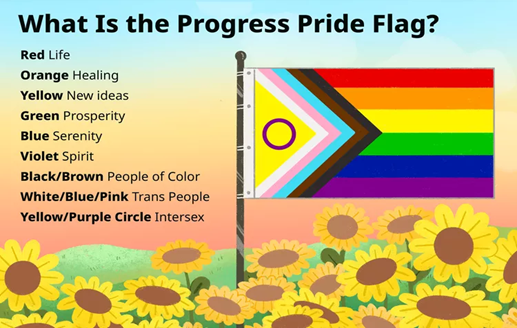
That said, the rainbow flag is evolving. There are now dissent pins, more inclusive pins and flags. There are over fifty different pride flags available. Surely there is something for everyone.

!

 That people argue over what pride flag to fly and what each pride flag means misses the point entirely. The message is one of radical welcome in the name of Christ. The meaning is one of unconditional love and safety for all people. Different groups name the stripes different things. People disagree about what flag to fly and what meaning each stripe should have. Leave it to a bunch of church people to take something that is meant to represent unity, and pick it apart until it has lost all meaning. Leave it to a bunch of church people to find something wrong with every symbol because it doesn’t represent their particular hobby horse. PICK A FLAG AND FLY IT WITH FAITH AND PRIDE.

Oh, the Places You’ll Go

Today is the forty-first anniversary of my ordination. On this June day, I stood in front of 300 or so people, quaked out my vows, felt the hands of my new colleagues on my head and shoulders as I took on the office of ministry. There is nothing special about forty-one years, but every year on this day I reflect on this weird and wild ride that is a life in ministry. It’s a bit like Dr. Seuss…”Oh the Places You’ll Go.” Every year different things come to the fore. Here are this year’s reflections.

I was ordained six weeks before my twenty-fifth birthday. I should have had “clueless” tattooed across my forehead. At some level I knew that I didn’t know nearly enough to launch me into this life, but I blundered forward as best I could.  That I didn’t screw up worse than I did is testimony to grace and the power of the Holy Spirit. And though I know a lot more now than I did then, I still have moments of cluelessness.

I have spent almost fifty years in service to the church. I was ordained to the ministry of word and sacrament and the office of pastor and teacher. This continues to shape my life. I believe in the power of the gospel to transform just about anything that needs to be transformed. That said; the church is a helluva disappointment in many ways. I have moments when I wonder if my service to the institution has been in vain. It is such a screwed up mess. 

I have seen churches wrenched apart by conflict that goes on for generations, an ecclesiastical version of the Hatfield’s and McCoy’s. I have seen the worst of what church people can be. I have seen clergy violate the trust of their office and leave a mile wide path of destruction in their selfish and broken wakes. I have seen churches mired in “the way we’ve always done it” to the point where they choke the life out of what’s left of their living history. Still, it’s what we have (for better or worse) for the ministry of the gospel.

Still, I believe in the life giving, life affirming radical love that is the heart of the gospel. It’s just that I am so disappointed that the church is such a miserable failure at living that out. Now the unofficial keeper of the social status quo, the church has forsaken its role as a radical agent of transformative love and justice making change. It’s enough to make this preacher wring her hands.

Yet, I still stand up every Sunday and preach from the center of my being, because it is what I am called to do. I want to believe it makes a difference but sometimes it is hard to tell. As Scripture reminds us, “God gives the increase.” It’s not about me.

Still, it’s not all gloom and doom. I have seen the church rise to the occasion of local need, global struggle and desperate pain. I have witnessed the healing power of community to reach to the heart of human brokenness and bring hope. I have felt the movement of the spirit when the word comes alive in the preaching and the listening energy is enough to blow me out the back of the chancel. I have witnessed individuals come alive in their faith and be “born again.”

Still, I believe in the ministry of word and sacrament. I believe in the value of gathering at the table to be nourished by the gifts of grape and grain and standing at the baptismal font to bear witness to the promises made with water.

Still, I believe the church has the potential to be transformed, if it can just get out of its own way. If the church can worship God more than it worships its building, it may have a chance. If the church can be the radical life giving community that Jesus intended and intends it to be, there may be hope for the institution. If the church can grow enough in grace and faith to embody a PART of what is called for as the new community in Christ, there may be hope. I have no vested interest in whether the church in its current incarnation survives. Sometimes I think the church should be like a phoenix and rise up out of the ashes of the past into something new and exciting. But the fire has to come first.

I’ll get the matches.

Why We Need Pride Month

A good reason to celebrate Pride Month is that it makes the religious fundamentalists and social conservatives uncomfortable. Spewing their hatred and judgment, they try to out-shout the out and proud people who march in parades…and they fail. It’s a beautiful thing.

The best reason to celebrate Pride Month is because it is all about hope. It is a witness to LGBTQ persons, especially youth who are fed hatred and bigotry instead of love and acceptance. Consider these chilling facts:

  • Suicide is the second leading cause of death among young people aged 10-24 (Hedegaard, Curtin, and Warner, 2018)—and lesbian, gay, bisexual, transgender, queer and questioning youth are at significantly increased risk.
  • LGBTQ youth are more than four times as likely to attempt suicide than their peers (Johns et al., 2019; Johns et al. 2020).
  • The Trevor Project estimates that more than 1.8 million LGBTQ youth (13-24) seriously consider suicide each year in the US—and at least one attempts suicide every 45 seconds.
  • The Trevor Project’s 2022 National Survey on LGBTQ youth Mental Health found that 45% of LGBTQ youth seriously considered attempting suicide in the past year, including more than half of transgender and nonbinary youth.
  • Data show that bisexual youth report higher rates of depressed mood, bullying, sexual assault and physical harm.
  • LGBTQ youth of color reported higher rates of attempting suicide than their white peers in the last year (12% white youth, 21% of Native/Indigenous youth, 20% of Middle Eastern/Northern African youth, 19% of black youth, 17% of multiracial youth, 16% of Latinx youth, and 12% of Asian/Pacific Islander youth).
  • Black transgender and nonbinary youth report disproportionate rates of suicide risk—with 59% seriously considering suicide and more than 1 in 4 (26) attempting suicide in the last year.

These statistics are from the Trevor Project website. The Trevor Project provides crisis services, advocacy, research public education, and TrevorSpace (a safe international community)

If this has not captured your attention, consider this. Much of what is represented in these statistics is wrapped up in a distorted theology of who God is and what God is about. LGBTQ youth and adults are barraged by the media with messages that God hates them, they are condemned to hell, they must repent, and the like. Every day children are cast out of their homes because their parents have internalized a message of hate about LGBTQ individuals. Research shows that LGBTQ are 120% more likely to experience homelessness and that up to 40% of homeless youth are LGBTQ.

To all the Open and Affirming, Welcoming and Affirming, Reconciling Congregations and faithful allies of the LGBTQ community…it takes more than a rainbow flag flying over the front door to get the message of God’s love across to those who have been beaten over the head with a bible by people trying to pray the gay away.

Being a gay friendly community asks something of us. It requires risk. The vast majority of Open and Affirming congregations I encounter in the UCC proudly fly their rainbow flags and proclaim that all are welcome. Their hearts are in the right place, and I celebrate the steps they have taken to be an inclusive community. More, however, is needed.

It takes a tremendous amount of courage for someone who has been traumatized by religion to walk in the door of a church. I don’t care how many rainbow flags festoon the building. I have heard too many stories of members of the LGBTQ community visiting an “open” church only to have no one talk to them, give them anything but a perfunctory welcome, and perhaps stare at their non-conforming attire. Of course we do that with straight people too, so it’s nothing new. But the damage done to someone who has mustered all their courage to walk in the door  is devastating.

What is most tragic, though, is that the heart of the message is never delivered or received. That message is the radical, inclusive, all embracing, joyous love of God who celebrates each and every person just as they are. What is never communicated is that they are truly welcome because this God we worship throws the door open wide to all who hunger and seek, and to all who need healing. The very heart of God is opened with the front door of the church to embrace everyone who walks in the door. The God we worship is a place where one can “unlearn” the hateful, distorted theology they learned that judged and rejected them.

We need Pride Month and we need people of faith to march in gay parades with signs that advertise their church. Straight people need to show they are allies to the gay community. Newspaper editorials and articles are needed to show a loving Christianity that is trying to drown out the voices of hate that are thinly veiled in a distorted view of what faith.

If you’re going to hang a rainbow flag, be prepared to live a rainbow life. Otherwise, don’t bother. The damage you reinforce will be even harder to unlearn.     

Further Down the Road to Fascism

Yesterday, Florida’s Republican Governor and soon to be presidential candidate signed SB 1580 into law. This allows health care providers to deny medical care on the basis of moral, ethical or religious belief. The law also allows insurance companies to refuse coverage for procedures if they go against their stated moral or religious guidelines. Further, the bill grants full immunity from liability for any negative consequences resulting from their denial of care.

There are so many things wrong with this law it is hard to know where to start. That it ever got far enough to be signed into law is difficult to believe. This amounts to state sanctioned discrimination in the delivery of health care services.

The bill has a broad definition of healthcare payors. It includes any employer, health insurer, health plan, HMO, “or any other entity that pays for or arranges for payment of any health care service.” The law also has a broad definition of health care providers. According to the ACLU of Florida, “This bill is so overly broad that it includes not just doctors, but any health care provider or facility licensed under a dozen different statutes, including doctors, nurses, pharmacies, hospitals, mental health providers, medical transport services, clinical lab personnel, and more. It applies to both public and private schools, colleges and universities.”

I have questions. For example, a woman is in a motor vehicle crash and goes to the hospital for emergency medical care. This woman happens to have very short hair, several tattoos and multiple body piercings. On the SUSPICION that she MIGHT be gay, hospital personnel can deny her the care she needs AND be protected from any liability for doing so.

How does one determine if someone is gay? Is it by looks alone? Is there an interrogation? Is there some state ID that is issued? It sounds like we are heading down the road to yellow stars on sleeves.

And Ron DeSantis is running for president. One of his slogans is “Make America Like Florida.” If elected, his broad reaching powers have a more than average chance of making national laws that protect segregation and privilege, whitewash our history, undermine civil rights and push us further down the road to fascism.

Broadly defined, fascism is an extreme political movement that emphasizes nationalism, militarism and the supremacy of both the nation and a, powerful leader over the individual citizen. It opposes socialism, pluralism, individual rights and equality and democratic government.

I didn’t think America could survive a repeat of #45. I’m not sure our country can survive a DeSantis presidency either. The gerrymandering of voting districts will make it almost impossible for any democrat to win in any election. I am not an alarmist, but there is more than a little reason to be very nervous.

And here’s another disconnect. About 444,500 people moved to Florida between July 2021 and July 2022. Florida has a robust economy, with an unemployment rate of 2.6%, compared to 3.4% nationally. The median household income is $57,703, compared to $31,133 nationally. On the surface it looks pretty good. But the non-monetary costs of exclusion, bigotry, erosion of civil rights and systemic racism make it hard to see Florida as a desirable place to live.

Personally, I think it’s time to boycott Florida. I cannot in good conscience give them my tourist dollars. If I get sick in Florida, as a gay woman I might not be able to get the health care I need. I might be denied visitation privileges with my spouse. The scenarios that play out are terrifying.

It’s easy to think that my little boycott will have no impact on Florida, and it is probably true. But living my conscience is part of what it means to be faithful and to have integrity. And “two and two and fifty make a million”, as the old song goes. I know many of you, dear readers, have property in Florida and vacation in Florida. I vacationed in Florida this past year–but not next year. We have to put our money where our mouths are. It is part of loving our neighbor as ourselves–our gay neighbor, our black neighbor, our trans neighbor, our immigrant neighbor, our Muslim neighbor. If we have not love, we are noisy gongs and clanging cymbals as 1 Corinthians 13 reminds us. And love is not mushy-feel-good-warm-fuzzy-schmaltz. It is clench fisted denial, protest, making our voices heard and not backing down from what we know is right, true and just.

We forget that as consumers, we are the most powerful group. By choosing where we put our tourist dollars, how we spend our disposable income and where we put our civic and national efforts, we have the power to change things. And things need to be changed.

Like Church, Only Not

Since my blog last week many have written to share their stories with pets that have touched their lives. I love hearing from you. Thank you for writing.

One comment reminded me that organized religion is not everyone’s cup of tea. Yet, the desire for connection remains. Enter “The Nearness.” According to a story from the Religious News Service, “The Nearness is an online community where people of all religious and non-religious backgrounds can nurture and define what spirituality looks like for them outside of traditional religious institutions.” You can learn more about The Nearness here.

Casper ter Kuile and Alec Gerwitz founded The Nearness last fall. Their vision for this online community came from a desire to have different religious experiences than those provided in their childhood.

The Nearness provides courses on various topics and engages leaders from various traditions and philosophies. The courses provide guidance as well as “prompts for reflecting, asking questions, finding connection and experimenting with new practices and rituals.”

The Nearness is a community that has appeal to the ever growing population of the spiritual but not religious. This online community is a place where everyone is welcomed and affirmed, a place where people can be honest, as well as give and receive compassion. As an aside, it is a pathetic commentary on the church in general that so often it is NOT. It is interesting to note that many people who participate in this community are still affiliated, but not connected to a congregation.

For years research has shown that the single largest factor in member retention in religious communities is making significant friendships with other members. Ter Kuile notes that the data show that fewer people are making significant relationships within the church. Their  feelings of disconnection and isolation cause them to cease participation.

This does not bode well for the church. That said; I have no investment one way or the other in whether the institutional church survives. In fact, in its current incarnation I think it needs to die.  How such a radical, countercultural community of ordinary people, misfits and outcasts became the symbol of the status quo in a capitalist, success oriented, consumer culture is mind boggling. Perhaps in place of the thousands of churches that are closing every year, new vital communities that offer what people need and a vision for how to serve others might spring up. It’s pretty clear that the current model isn’t working.

In addition to groups for learning and growing The Nearness is experimenting with different kinds of rituals to ground significant life experiences. One thing that remains with people who may participate in religious life at no other time is that they often want to be married in a church, have their children baptized and have a minister preside over their funeral. Creating rituals apart from traditional religious ceremonies, allows significant life cycle events to be grounded in community and in ceremony.

I think The Nearness is on to something here. Maybe the church can learn a few lessons. Online opportunities for group participation, more small group interaction and a true spirit of hospitality are a good place to begin. Then, if the church could lose its self-righteous piety it might have a fighting chance.

Most of What I Needed to Know

Robert Fulghum may have learned what he needed to know in kindergarten. Much of I what I need to know I have learned from my dog.  Here are a few lessons from dogdom that have taught me something about the kin-dom, faithfulness and discipleship. 

Bark with your buddies.  Barking is an act of community.  When a dog barks, dogs in the distance answer.  Barking says we’re all in this together. “Improved communication” through electronics may make us more connected, but it fails to provide human contact. Being in community is, however, important.   

There’s a reason worship is central to a life of faithfulness. We are created to live in community.  Yes, we can pray on our own, connect with God on the mountains, water or golf course; but there is no substitute for corporate worship. Singing praise together, praying for one another and greeting one another in the spirit and love of Christ are an essential part of spiritual wellbeing.  Part of being a follower of Jesus Christ means gathering regularly for the encouragement of fellowship.

Greet loved ones with a wagging tail.  Nothing is more important than feeling loved, and there’s not a creature on the planet that does it better than a dog. One of the things I miss the most about my dog, Pearl, is that no matter how big a jerk I may have been on any given day, Pearl was happy to see me and ready to give me a slurp.  She reminded me that unconditional love is a beautiful thing and that I have a long way to go before I am even close to embodying it in my own life. 

Dogs remind us that loyalty is a good thing. Loyalty has fallen on hard times in our fickle culture as we are sometimes quick to trade in our friends, jobs, churches and spouses when the going gets tough; but loyalty it is a critical element of discipleship.  In Christ we are invited to a new relationship for a lifetime, not for a season, not for a time, but for all time.  And like all relationships, ours with God knows seasons. As the disciples anticipated tough times, Jesus reminds them and us that we continue to belong to God.

Eat with gusto and enthusiasm.  You know how dogs eat, slobber flying everywhere, chasing the dish across the floor to get every last morsel.   Twice a day Pearl would jump around and bark and couldn’t wait to dive into her food bowl. Watching a dog at mealtime is a great reminder that eating is a celebration of life. 

Breaking bread together is holy.  To nourish the body is not a chore, but a sacrament.  Eating together is deeply intimate. Barriers are broken down, relationships are renewed and nourished, and friendships are born and strengthened.  Eat with gusto; enjoy all the flavors and spices of creation.

We are also reminded of the basic need that all have for nourishment.  In this troubled world economy it is frightening to think that a basic commodity like rice, a staple for millions of the poorest of the poor, is becoming more and more expensive.  Riots in around the world and the increased numbers at meal sites and food pantries are not just social tragedies, but defining moments for God’s people.  Each week the local food pantry is all that stands between people and growing hunger right here in our own communities.

Run, romp and play daily. Physical exercise is as important for the soul as it is for the body. Pearl was absolutely unabashed in her demand for daily exercise and attention.  She would sit at the door and bark until one of us went outside to throw the disgusting tennis ball that was her constant companion. Or she would look at the leash and bark.  Through the years I’ve had a lot of pets–dogs, horses, cats, goats, chickens, you name it. Caring for them was always a welcome discipline and a reminder of how important it is to tend to physical needs. 


When you’re happy, dance around and wag your tail. Thankfulness and celebration are powerful dynamics for healthy living. Gratitude is a spiritual discipline that helps us affirm the essential goodness of life.

Even when adversity strikes, gratitude helps us maintain our perspective and carry us through the low moments. And when I speak of gratitude, I don’t mean some schmaltzy, shallow, put on a happy face crap. Pearl reminded me to cultivate gratitude through simple things.  In the grand scheme of things she didn’t ask for much–a few minutes of my undivided attention, a short walk a couple times a day, decent food, a safe dry place to sleep– and she was happy. 

Learn to be present.  At the Nursing Home, Pearl would visit with other residents and she was different with each of them.  If a person was playful she would be too, if they were withdrawn she would quietly sit down beside them.  

Watching Pearl reminded me of the value of sitting close by and being present.  I may have said this before, but one of the most valuable things I learned from my mentor is that, “when you don’t know what to say, for God’s sake, shut up.” 

This is a challenging and complicated life we all lead and there is no doubt that we are in need of comfort and encouragement.  I’m not suggesting that everyone run out and get a dog. I am suggesting that looking for simple places to find comfort and encouragement is a balance to what can be a difficult time in life.

Finally, when you choose to surround yourself with lives even more fragile than your own, you learn that time is fleeting and life is precious. Pearl passed from our keeping to God’s a bit ago, taking her place with the canine, equine and other critter companions who have graced my life through the years.

The truth is that each day is filled with opportunities and invitations that make the difference between merely existing and truly living. May you find the simple things that bring comfort, encouragement and glimpses of peace and joy.