
They Shall Beat Their Swords into Plowshares and Their Spears into Pruning Hooks

the minority report on faith and culture
Isaiah 2:1-5
The word that Isaiah son of Amoz saw concerning Judah and Jerusalem. 2In days to come the mountain of the Lord’s house shall be established as the highest of the mountains, and shall be raised above the hills; all the nations shall stream to it. 3Many peoples shall come and say, “Come, let us go up to the mountain of the Lord, to the house of the God of Jacob; that he may teach us his ways and that we may walk in his paths.” For out of Zion shall go forth instruction, and the word of the Lord from Jerusalem. 4He shall judge between the nations, and shall arbitrate for many peoples; they shall beat their swords into plowshares, and their spears into pruning hooks; nation shall not lift up sword against nation, neither shall they learn war any more. 5
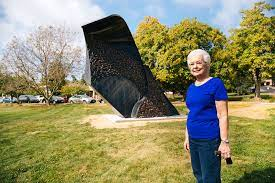
The Advent photo is a sixteen foot plow share. What makes this piece unique is that it was crafted from over three thousand hand guns collected by and surrendered to the police in Washington DC over a two year period.
It was unveiled on September 19th 1997, and for twelve years stood in the middle of Judiciary Square in Washington. It is not currently on display.
It is the creative work of Esther Augsberger (a sculptor from Eastern Mennonite University) and her son Michael. It is a powerful and stunning witness to one family’s commitment to peace and a reminder that this is both the promise and the dream for our world.
The base of the sculpture quotes Isaiah, “they shall beat their swords into plowshares and their spears into pruning hooks.”
In this first week of Advent the ancient words of the prophets bring both challenge and hope. They give voice to what we yearn for. They tell us peace is the promise; peace is the work; peace is the way.
The way is hidden in plain sight in the words of the prophet Isaiah. We are so familiar with the swords into plowshares verses that what comes before can slide right by unnoticed.
As we look at the text it’s important to remember there is a linear order to things. Peace is the outcome, the end result. There are some important things that come before.
Peace is an uphill journey. Verse two suggests a wonderfully subversive image: God’s people, all nations will stream uphill. Stream is a verb that usually refers to water. And water flows downhill, because gravity is the law. But God’s people will stream uphill against the flow.
Peace is an uphill journey a counter cultural commitment to be the people of God when it would be easier to be just about anything else.
In Isaiah’s time the mountains of nationalism and economic security were higher than the mountain of faith. Isaiah pointed it out for them. He exposed their commitments and actions for what they were–idolatry pure and simple. The message is relevant for us today.
Now you know why prophets were not welcome in their own lands, truth be told they weren’t welcome any place else either. Isaiah pointed his finger at his own kin and brought a word from God that named their errant commitments as well as the violence within them that kept them from peace. He looked at his friends and family and said there is no peace, because you have not streamed up the mountain to learn the things that make for peace.
The uphill journey often begins alone. The prophetic task is often the voice of one: one person who speaks truth to power; one person who journeys uphill again and again. Isaiah was not sitting around waiting for peace to drop out of heaven. He was streaming up the mountain toward it. Whether or not anyone followed him was not the point. The journey was his to make; the truth burned within him and he was faithful to the task.
We are so often caught in powerlessness, thinking that our little actions will not make a difference, and thinking or perhaps fearing either irrelevance or failure. What is ours to do we do not do. Isaiah’s witness is to the power of one.
Peace is an uphill journey that we choose to make, or not make, every day. A deep commitment to peace means we live out individually what is needed collectively. It’s not about whether or not we change the world, that’s up to God. But this much we know, and Thich Nat Hahn said it best: “there is not a way to peace, peace is the way.”
It begins with what we do or fail to do every day. As people of faith we look first at our own lives and clean up what is ours to clean up. We are impacted by the violence that is as much a part of our world as the air we breathe. We think that we are unaffected by it, and that is the first illusion that needs to go.
There is violence in our language. We think in terms of win or lose. We need to be right, sometimes at the expense of relationship. We pass self-superior judgments on others. We resist the spiritual work of reconciliation.
Dreaming God’s dream for the world is a daily discipline that needs silence and solitude. Such disciplines occasion the kind of insights that lead us and strengthen us for the uphill journey.
It is a discipline that also unravels our fears. Most of what sets us at odds with one another is fear: the fear of being wrong, the fear of one who is different, or the fear of what others will think if we associate with “that person”.
The uphill journey that will finally beat swords into plowshares and spears into pruning hooks is a journey of personal transformation that is supported and held accountable in the life of community. The uphill journey does not ask if one person can really make a difference. It stands as a witness that leaving things undone is a resignation to despair.
The most important work for peace is the work that begins inside us: routing the violence from our language and looking the people we see every day straight in the eye and seeing them as God’s beloved. It sets us on the lifelong uphill journey to the things that make for peace.
Faith, such as we have and such as we hope for, calls us to look at these things; because peace in the world depends on peace in the country, which depends on peace in the community, which depends on peace in the home, which depends on peace in the heart. Just because things have been the way they are for so long doesn’t mean it’s the way they are supposed to be.
Only in America can people gather on Thanksgiving Day around a table laden with food and give thanks for their blessings. The next day they trample people on their way to buy more stuff for people who already have too much.
Black Friday madness officially welcomes the beginning of unbridled consumerism. The National Retailers Association estimates that Americans will spend 942.6 billion dollars on holiday gifts, decorations and food. This shatters last year’s record of 889.3 billion. Despite inflation and concerns about the economy, people are planning to spend and spend big.
As a result, fifty percent of shoppers say they will take on short term debt, including predatory lending such as pay day loans. According to a Nerd Wallet survey, 31% of people have not paid off their holiday spending from last year. The average American household will spend $1455 dollars this season. So important is this brief burst of frenzied shopping that it is used as an economic indicator for the coming year. Supposedly, holiday shopping measures consumer confidence in the economy.
There is a cost to all this holiday hoo-ha that goes far beyond the credit card bills that roll in during the month of January. For those who tend toward anxiety and depression, seven percent have considered suicide. Constant worry is a problem for fifty-three percent. Another thirty-one percent have difficulty sleeping. Significant percentages of people also stress-buy items they cannot afford, increase their alcohol consumption or experience mood swings. Even for those who do not tend toward anxiety and depression, holiday stress barges in the front door with pressure to buy and bake, entertain and indulge.
The ultimate irony of all this madness is that it is grounded in a tradition surrounding the birth of Jesus. He was a poor Middle Eastern Jew who was homeless and hated for his teachings about the proper use of riches and the need to care for the poor.
It is not known when Jesus was actually born and most of the stories around his birth are myths. That is not to denigrate the stories in any way, but there’s a good chance the stories aren’t factual, but they’re true. The question to ask about these stories is not, “did it happen exactly this way?” Rather the question is, “what do these stories mean for us today?” What can we learn from being a follower of Jesus rather than one who simply worships the baby during the Christmas season?
Instead of a season of unbridled consumerism, here are some suggestions for alternative celebrations that cut down on the madness, the debt and the hoo-ha.
If you are one that laments that there is no Christ in Christmas, then engage in the activities that make Christ manifest in the world.
Yesterday the population of our planet reached eight billion people. A new report by the United Nations indicated there are a number of population trends to which we should be paying attention. The report states, “This is an occasion to celebrate our diversity, recognize our common humanity, and marvel at advancements in health that have extended lifespans and dramatically reduced maternal and child mortality rates. At the same time, it is a reminder of our shared responsibility to care for our planet and a moment to reflect on where we still fall short of our commitments to one another.”
One area where we fall desperately short of our commitments to one another is in care for refugees. It is estimated that at the end of 2021 there were 89.3 million forcibly displaced persons as a result of persecution, conflict, violence or human rights violations. This includes 27.1 million refugees and 53.2 million internally displaced people (The United Nations Refugee Agency).
No one can forget (hopefully) the number of Central and South American people trapped in inhuman situations at the US and Mexican borders. Children in cages, people outside in scorching heat, and unaccompanied minors being deported alone to Mexican border towns. Under the reign of error from #45, immigration policies were set back decades. His administration fueled an anti-immigrant sentiment that continues. The current administration has tried to undo some of the policies, but has been blocked at every turn.
In other areas of the world, Poland especially, but also other European Union (EU) countries have welcomed millions of asylum seekers and refugees. According to the European Commission in 2021, 23.7 million people in the EU were non-EU citizens (5.3% of the total population) and 37.5 million people were born outside of the EU (8.4% of all EU inhabitants).
The global refugee crisis is far from static. According to www.concernusa.org there are at least ten refugee crises on the horizon, including the Central African Republic, Somalia, Sudan and South Sudan, Myanmar, Ukraine and Syria.
As long as there is political, economic and sectarian violence there will be refugees. It raises questions about where they will go, how they will be cared for and how countries can absorb such large numbers of individuals when they struggle internally with their own economies. Some countries are starting to remove the welcome mat. According to the New York Times, a small vocal group of Poles is ramping up resistance to taking more Ukrainian refugees. The United States has less than a stellar track record of welcoming refugees. Other countries are finding their resources stretched to the limit.
It’s time we look at planet earth as a global community. The artificial lines we draw around countries are the result of war, violence and power moves. If we erase the lines (an unlikely outcome), then we see our responsibilities to one another in a different way. It’s time for foreign aid to stop having quid pro quo undertones. It’s time for our strategic concerns to take a back seat to human need. Yes, we are dealing with world bullies like Russia and the threats are real. It’s a complicated problem to be sure, but we cannot absolve ourselves of responsibility for the millions of people who suffer through no fault of their own.
The truth of the matter is that there is enough for everyone’s need, but not everyone’s greed. Much of the anti-immigrant sentiments around the world have to do with not wanting to give up a certain lifestyle, not wanting to lose what is “ours” and being unwilling to share. Our prejudices and biases against “foreigners” have a long and unattractive history in the United States. The current incarnation against Central and South American immigrants should come as no surprise.
So maybe the place to start is with those prejudices and biases. Maybe we begin by opening our hearts to those who are displaced by famine, war and violence and trust that if we open our hearts the actions will follow. Maybe it’s time to support refugee agencies as part of our charitable giving. Those of us who claim the name of Christian cannot deny that Jesus was ultimately concerned about the poor, the outcast and the downtrodden. As long as power is related to privilege and skin color determines social standing and the “right” religion defines our response, the refugees of the world will continue to struggle against the cold heartedness of the rest of the world.
Please say you voted. If you didn’t vote, you don’t get to bitch about the outcome. Simple as that. If you did vote, thank you. Democracy only works when it is participatory.
It is likely the election results will not be known for some time. We can expect outcomes in close races to be challenged. Voting disinformation will abound. Efforts to undercut the integrity of the election process will challenge legitimate outcomes. It is far from over.
Now is not the time to think that you did your part because you voted. Now is not the time to throw up your hands in despair and check out. Now is not the time to listen to whatever comes over the airwaves as fact. Now is not the time to be a bench sitter. Be big, be bold, be loud. Be faithful. Being involved in the public sphere is an act of faith. It is the belief that our country can change when we vote our conscience and vote for the good of all people.
Free and fair elections depend on people who work the polls, count the ballots and register the outcome. Write to your Secretary of State and say thank you for doing their job with integrity. If there is a kerfuffle about counting all the votes in your state, be outraged and write to your Secretary of State about that.
Actively work to put disinformation to rest. This means you must be an informed citizen (something we should be all the time). Depend on reliable news sources for your information. Encourage family and friends to not succumb to the craziness that is out there.
Christian nationalism is a real and present danger to our democracy. People of faith (all faiths), and people of no faith who have a conscience have a duty to speak their truth. Remember, the religious right is not a majority; they just have the biggest mouths and a lot of money. They form power blocks and ingratiate themselves to politicians in a constant quid pro quo. If you have been silent, now is the time to speak up.
Write to your local and state legislators, even if the outcome of their election is uncertain. Say what your expectations are on crucial issues. Remind them they are servants of the people.
A senator once told me that he hears from less than fifty people on any given issue. A few phone calls, a few letters, a few e-mails and THAT IS IT! Our legislators cannot represent us if we don’t tell them where we are at. They will be guided by their own beliefs and their inner moral compass. This is not, as we have seen, always a good thing.
Thanksgiving and Christmas may be interesting this year. If we remain silent, falsehoods and misinformation will go unchallenged. It is important to remember that disagreeing does not have to be a knock-down, drag-out screaming match. Disagreement can happen politely and respectfully. It’s time to stop being afraid. It’s time to stop being apathetic. Our disagreement may not change another’s mind, but we can never underestimate the power of planting a seed.
It’s time to pray, protest and participate.
Check out the new book recommendation, How to Heal Our Divides
You weren’t permitted to visit in the hospital. You couldn’t hold your loved one’s hand in their final hours. You said good-bye to your partner, parent, sibling, child or friend via iPad. When their suffering was over, their body was placed in a refrigerated trailer behind the hospital. There was no funeral or memorial because no public gatherings were allowed.
This is the age of Covid 19. If this is your reality you share it with the families of 1.07 million people who have died since the beginning of the pandemic. You are not alone, but you may feel more alone than you ever have in your life.
If there is any good news in this scenario it’s this: It’s never too late to say a proper goodbye. Grief is a communal emotion. It is meant to be shared. We were never intended to grieve in solitude. We are creatures of community. Significant life events, both happy and sad, are things we want and need to share. We are also people of ritual. We need to mark and celebrate the big events of life and death.
If you were deprived of an opportunity to say a proper goodbye to your loved one, think about doing it now. Unresolved and unexpressed grief doesn’t go away. Time does not heal the wounds, it may blunt some of the pain but that’s all. In many ways grief is the companion of a lifetime when someone we love dies. That grief, however, is lessened when we have the opportunity to share it through a public gathering or ritual.
The cremation and burial may be long over, but that doesn’t negate the need for a gathering to honor your loved one and share your grief. There is no right way or wrong way to plan a memorial. There is your way, and that’s all that matters.
Invite a bunch of people, invite a few people or invite just the family. You choose who needs to be there for you. Read some poetry, play some of your loved one’s favorite music. Eat their favorite food. You may or may not desire to have a clergy person present. Figure out how you want it led and who you want to do it. Remember, you are doing this for you and for your loved one, and maybe for others who are in need of an opportunity to say a proper goodbye. Have it at your house, a restaurant, their favorite club or gathering space. Plan an outing to the zoo, go to the beach. The options are endless. What matters is that it is right for you and for the people who will share the event with you.
Grief that remains unexpressed can cause depression and anxiety. It can manifest in stress- related health problems like hypertension and digestive issues. Unexpressed and unvalidated grief can impact sleep patterns and cause chronic exhaustion. Weight gain/loss and self- medicating with alcohol or drugs are often part of unresolved grief. Emotional and spiritual health are impacted when grieving is done alone. Grief can become complicated mourning when it remains unexpressed.
Complicated mourning is a term coined by bereavement therapist Therese Rando. In her book of the same title she writes at length about the causes and impact of complicated mourning. It can happen when death comes unexpectedly, tragically or traumatically, or when grief remains invisible. All of the usual sadness and emotion are present, but they are not blunted by time. There is a sense of being unmoored from all that is familiar. It is difficult to find any source of happiness or joy. The usual rituals and celebrations do not happen for a variety of reasons. Sometimes, even when a “traditional” service is celebrated there is a need for additional social and communal affirmation of loss.
The National Institute of Health states, “Complicated grief is a chronic impairing form of grief brought about by interference with the healing process. We use the term ‘complicated’ in the medical sense to refer to a superimposed process that alters grief and modifies its course for the worse. Think about a physical wound that produces an inflammatory response as part of the healing process. A wound complication, for example an infection, increases the inflammation and delays healing. You can think of bereavement as analogous to an injury and grief as analogous to the painful inflammatory response and complicated grief as analogous to a superimposed infection.”
Complicated grief and mourning often need psychotherapeutic intervention. It’s important to know when you need help. A small piece of mourning can be lessened, however, by having a public ritual that acknowledges your loss and celebrates the life of your loved one. It is not a replacement for professional help, but it can be one small piece of validating loss and grief.
If you are one of the millions of people who are wandering alone in the wilderness of grief, you can help yourself by knowing that it is never too late and you are not alone. Let the celebration of your loved one’s life be a way point in your healing process.
(If you know someone suffering from unvalidated grief, please share this blog as a way of encouraging their healing.)
It is no secret that churches are facing declining membership. It is a cause of much handwringing and angst among church members and leaders alike. According to the Religious News Service the most recent survey of faith communities revealed a median decline in church membership of seven percent between 2015 and 2020. Half of the country’s 350,000 congregations have less than 65 people in the pew on any given Sunday morning. The exodus of members due to death and attrition is not balanced by the influx of new members. Average new member retention rates are less than fifty percent over five years. Taken together, it is not long before the projection of church longevity is in the single digits. In 2019 over 4,500 hundred Protestant churches closed according to estimates from the Nashville-based Lifeway Research.
The truth is, there are good reasons for declining membership and none of them have to do with cultural influences. In the interest of putting forth the biblical argument that we all tend to look at the speck in another’s eye while ignoring the tree growing out of our own face, here are a few thoughts about why the church is struggling:
It may be that 4,500 churches closing is a good thing. It may make room for a resurrection of what the church is called to be.
The landscape is littered with political signs. Every other ad on television is for a candidate promising to save the world. Thinly veiled mudslinging between candidates passes for debates. Hold on, it will all be over soon. Stay the course.
It’s a boating term; stay the course. It is a directive to the helmsman (the driver) to keep the boat on the same compass coordinates and thereby stay on the same trajectory for as many nautical miles as needed. There are no road signs in the ocean announcing “Martha’s Vineyard 16 miles, New Bedford go left in 8.6 miles” It all looks the same–lots and lots of water. A compass and a directive to stay the course is the difference between getting where you are going and ending up in the United Kingdom.
It’s like this during election season. All the stuff looks the same and most of it is BS. Sorting through it and figuring out what the real issues are and the candidates who are going to address them is like bobbing around in the ocean without a compass.
But, it is time to gather up your fatigue, stow your cynicism, dust off your bullshit-o-meter, and make a commitment to being an informed voter and exercising one of the most fundamental rights of being an American citizen, voting. It’s easy to think that our one little vote doesn’t matter. Nothing could be further from the truth. Mid-term elections are becoming very important. They act as a stage for positioning the presidential election that comes up in another two years. If the Republicans gain control of the senate, President Biden’s agenda for ongoing economic recovery, job creation and easing financial burdens on middle class families will be stonewalled.
Being an informed voter is of critical importance. The question is, informed by what? Surely we vote in our own self-interest. We are, however, called as people of faith to vote in the interests of the poor, the marginalized and the disenfranchised. Knowing the issues that impact your state as well as the national landscape is important.
Here are some points for reflection that bear repeating from a blog several years ago:
Another way to put it; vote as if:
The truth is that most all of these things can happen to any one of us. They have happened to far too many Americans who have not been treated with justice and equity. Vote in their interest too.
In an official act, the President of the United States issued the following:
“NOW, THEREFORE, I, JOSEPH R. BIDEN JR., President of the United States of America, do hereby proclaim October 11, 2021, as Indigenous Peoples’ Day. I call upon the people of the United States to observe this day with appropriate ceremonies and activities. I also direct that the flag of the United States be displayed on all public buildings on the appointed day in honor of our diverse history and the Indigenous peoples who contribute to shaping this Nation.”
It’s official. So, if you are one of those people who roll your eyes when you hear “Indigenous People’s Day,” I have three words for you.
Get over it.
If you are one of the people who proudly proclaim being “politically incorrect” by saying Happy Columbus Day, I have three words for you.
Knock it off.
This is not some politically correct trope. This is an honest effort to correct the revisionist history that has allowed us to celebrate Columbus as “discovering America.” In truth, Columbus discovered nothing. Newsflash: there were already people here. What Columbus did was begin a period of colonization that systematically exterminated hundreds of Native Nations and millions of Native Peoples.
A conservative estimate is that ten million Native Peoples were killed by disease, malnutrition and assaults on local villages. Make no mistake; disease is a tool of genocide. When smallpox was running rampant in colonial villages, blankets that belonged to deceased patients were given to Natives to infect them. The remaining villagers were slaughtered in ambushes. For a period of time there was a bounty on the scalps of the Penobscot Nation–30 Pounds for males and 25 for females.
The Indian Removal Act of 1830 expelled five Nations–Cherokee, Chicksaw, Choctaw Creek and Seminole–from their land (where colonists wanted to grow cotton) to what is now Oklahoma. This came to be known as the Trail of Tears. Over 4,000 people died of cold, hunger and disease.
During the gold rush of 1848, thousands of Native Americans were displaced or died of starvation or disease due to the contamination of their land and water from mining by-products.
After the end of the American Indian wars in the late 1800’s, it is estimated that less than 238,000 Native Americans remained.
The wholesale death of ten million Native Americans is extreme in comparison to recent genocides: 6 million Jews and 800,000 Rwandans. There seems to be no end to the violence human beings do to each other, for no other reason than being different.
Much of the following history has its root in the doctrine of discovery, a concept of public international law expounded by the United States in a series of decisions of the Supreme Court. It is based on various church documents in Christian Europe in the mid 1400’s to justify the pattern of domination and oppression by European colonists. It theologically asserted the right to claim the indigenous lands, territories and resources on behalf of Christendom. Further, it legalized the subjugation of native peoples. To this day the US courts still claim this precedent to decide property rights cases brought by Native Americans.
In 1900, the Supreme Court voted that the US government had the right to overturn all Cherokee Law. It is one in a long line of Federal laws and local ordinances that diminished Native Peoples around the country. In 1924 dual citizenship was granted to Native Americans; they were allowed to maintain citizenship in their Native Nation and were declared US citizens. Columbus Day became a Federal Holiday in 1937. In 1940 the Hoover Commission urged assimilation which further eroded the identity of Native Peoples. It was not until 1965 that Native Americans gained uniform voting rights. It was not until 1968 that Native Americans were granted free speech, the right to jury and protection from unreasonable search and seizure. It was not until 1978 that the Child Welfare Act was passed. It protected Native parents’ custody of their children. Despite this law, there is ample evidence that Native Children are still removed from their parents at a higher rate than other children, especially in South Dakota.
Given this horrific history, there is ample reason to stop celebrating the chain of events begun by Columbus and to now lift up the Native Peoples of our nation. The first Indigenous Peoples Day was officially recognized in South Dakota in 1989. Since then Alaska, Maine, Minnesota, New Mexico, North Carolina and Vermont have officially recognized Indigenous People’s Day. One hundred and thirty cities around the country have also changed their celebrations to Indigenous People’s day.
The protestant church is actually leading the way in this developing trend. The United Church of Christ officially changed its designation of the holiday after their General Synod 29 and has continued to advocate for repudiation of all legislation related to the doctrine of discovery. Other Protestant denominations have, in various ways, followed suit.
A designation of Indigenous People’s Day is to balance the colonizing history represented by Columbus. It affirms the rights and essential human integrity of Native Peoples and their right to live in peace and maintain their tribal identity. It is one small symbol in a long history of betrayal, broken promises and horrific treatment that may gradually shift the focus from a genocidal, racist, pro-slavery colonizer to a more honest focus on those who have been and continue to be marginalized.
If you roll your eyes when you hear Indigenous People’s Day, get over it.
It’s not every day you get an e-mail from a family member saying, “In three days I will be dead.” My spouse’s cousin was writing to the family to say goodbye. He was following through on a long talked about, debated and wept over decision to end his life on his terms. He had a chronic disease that was entering its terminal phase. He had said for years when it got to that time, he would choose to end his life. He was sending final correspondence to his family via email.
Most of us have no idea when we will have the last conversation with a loved one. Too often it is at the death bed through tears and the realization there is not enough time to say everything that needs to be said. At some level it is a rare gift to know, and not miss the opportunity to say everything on one’s heart and in one’s mind. If there is one lesson to be learned it is–don’t wait to tell your loved ones what you want them to know. Chances are good you will not know when the last conversation is. There is tremendous power in saying the words, “I love you” aloud. There is tremendous healing in articulating to someone what they mean in your life and how your life is better because of them.
Everyone has a different experience of suffering. The loss of independence, sense of self and the fear of being a burden to family members are just a few components of suffering for some patients. I would venture a guess there are as many types of suffering as there are people who are dying. While there is always a way to manage pain and other sources of suffering, people do on occasion “seek the assistance of a physician to end their life.” (American Academy of Hospice and Palliative Medicine or AAHPM).
In the area where my spouse’s cousin lived, physician assisted dying is legal. In the United States physician assisted dying is legal in ten states and the District of Columbia. It is hotly debated in other states from time to time.
The AAHPM released a statement in 2016, “Physician Assisted Dying (PAD) is defined as a physician providing at the patient’s request, a prescription for a lethal dose of medication that the patient can self-administer by ingestion, with the explicit intention of ending life. Although PAD has historically not been within the domain of standard medical practice, in recent years it has emerged as both an explicit and covert practice across various legal jurisdictions in the United States. PAD has become a legally sanctioned activity, subject to safeguards.”
According to www.compassionatechoices.org, “Medical aid in dying is not assisted suicide, suicide or euthanasia. Medical aid in dying is a safe and trusted medical practice in which a terminally ill, mentally capable adult with a prognosis of six months or less to live may request from his or her doctor a prescription of medication which they can choose to self-ingest to bring about a peaceful death.”
Language is important. “Leading medical organizations such as AAHPM and the American Public Health association have all adopted policies rejecting the term “physician assisted suicide.” The American Association of Suicidology, a nationally recognized organization that promotes prevention of suicide through research, public awareness, programs, education and training comprised of respected researchers and mental health professionals, asserts medical aid in dying is fundamentally distinct from suicide.” (Compassionate Care)
The alleviation of human suffering and pain should be at the forefront of any discussion on the subject of medical aid in dying. How the patient experiences suffering is the conversation that matters. The moralizing that happens when (perhaps) well intentioned religious and ethical wannabes judge another’s life is itself a source of suffering.
Three principles can guide our thinking and conversations about end of life, whether physician assisted dying is under consideration or not:
 The Irreverent Reverend