A Kiss is Just a Kiss until it’s not

When the Spanish women’s soccer team won the World Cup, Coach Luis Rubiales kissed Jennifer Hermosa on the lips. He said it was consensual. Here’s why it wasn’t.

Any kiss that happens when a woman’s head is held on either side by a man’s hands is not consensual. In essence he had her head in a vice grip. There is no consent when you can’t move your head. This was not a kiss, it was sexual assault. To those of you who think this is overblown, after all it was just a kiss, it’s time for some remedial education about the agency women have over their own bodies.

Equally troubling is what has happened since then. These events point to a culture of misogyny and sexism that is more than an isolated assault. It’s just that this one happened on international television.

Rubiales flatly refused to resign his position as Coach stating that he was the victim! The position of Coach is a powerful one in the lives of players. The one who has the power always has the responsibility to set and maintain an appropriate boundary. He claimed he was a victim of “false feminism” and said he was being “socially assassinated.” It implies that the women never complain about the other things that happen on the team and now that there has been a public sexual assault, their feminism is somehow feigned and therefor dismissed. What a crock. The issue here is that he is being held accountable for his behavior and he doesn’t like it one bit. Rubiales plays the feminist card to deflect attention from his own behavior and shift responsibility from him to Ms. Hermosa.

Rubiales, who is also the head of the Spanish Soccer Federation, said he should be more careful when acting or speaking on behalf Federation. Nowhere in his comment is any commitment to not sexually assaulting women. That speaks volumes about the culture of women’s soccer. He also refused to resign his position with the Federation. He has since been suspended.

The Spanish Soccer Federation released a statement on Ms. Hermosa’s behalf stating that it was a spontaneous mutual gesture. No, just no. He further disempowered her by putting words in her mouth and dismissing the comments she made directly to the media.

 Rubiales made a comment that this was the same kiss he would give his daughters. Quick, someone call Child Protective Services. He is teaching his daughters that men can control women’s bodies and touch them how and when they wish. He is diminishing the agency his daughters have over their own bodies.

His “apology” is a typical non-apology. “I’m sorry you felt that way.” Women who are sexually assaulted do not need men apologizing for their feelings. It is demeaning. A real apology looks something like, “I am so sorry, I was totally out of line.”

There is a pervasive unspoken culture that men have access to women’s bodies, not needing their consent or permission. ATTENTION ALL MEN: You need permission to touch our bodies. And we deserve to set limits on how our bodies are touched without recrimination or name calling. Men need to take responsibility for their behavior and respect women’s bodies. Period.

As a woman in a historically male profession, I am continually astounded by the access men assume when it comes to my body. Over the last forty-five years I have been subjected to unwanted hugs and kisses, an arm around the waist or the shoulder, inappropriate comments about how I am dressed, or about particular parts of my body. When I speak up and set a limit I have been called a rabid feminist, a bitch, hypersensitive and not able to take a joke. This pervasive assumption of access to women’s body is the result of living in a patriarchal society. Men have more power, men are valued over women and women are objectified. Women are often professionally evaluated on the basis of our looks rather than our skills. While it is somewhat better now than it was forty-five years ago, there is still room for improvement.

So, should Rubiales resign? Absolutely. There needs to be a severe consequence for sexually assaulting a woman on international television. A clear message about the abusive nature of his behavior needs to be sent to the international community. Sexual assault has a lasting effect on women. It is time there was some consequence for men.

Imagine

Imagine 6,500 people from 95 countries representing 212 religious traditions gathered in one place to work together to address the most pressing issues of our world.

No need to imagine. The Parliament of World Religions started its meeting August 14, 2023 in Chicago, IL. The purpose of their gathering is to build trust, relationship and interfaith collaboration, to address the crucial issues of our times.

Why this is not smeared across the front page of every newspaper in the country, all social media and every news outlet is a mystery to me. This is big stuff. Leaders come together with the belief that interfaith collaboration holds a key to solving the ills of the world. They come with an attitude of respect and openness, acknowledging the differences in faith and believing in the possibility of unity, which is not to be confused with uniformity.

Unity enables diverse groups of people to come together around shared values and goals, working together for relief and solutions for those in need. Uniformity tries to shove everyone in the same mold and have everyone come out looking the same and believing the same. Needless to say, it has never worked.

Not intending to be cynical, but given that protestant churches can’t agree on whether to say “debts” or “trespasses” in the Lord’s prayer, or if/how the actual presence of Christ is in the Lord’s Supper, it seems like a tall order to address religious genocide, sectarian violence, and the plethora of religious dissensions that exist around the world.

Still, it is a great idea with a great history. According to the website of the Parliament of World Religions, “The organization was founded on a mission to cultivate harmony among the world’s religious and spiritual communities and to foster their engagement with the world and its guiding institutions to address the critical issues of our time. The Parliament was incorporated in 1988 to carry out a tradition and legacy that dates back to the 1893 World’s Columbian Exposition in Chicago, where the historic first convening of the World’s Parliament of Religions created a global platform for engagement of religions of the east and west.”

It seems that a little trickledown energy would be a good thing here. We know trickledown economics doesn’t work, but maybe trickledown energy and learning might. Imagine if religious leaders from a community came together and talked about something other than dwindling memberships and budget problems and pooled their energy and money on a project that could make a real difference in people’s lives. For example, an after school program for kids that includes tutoring, joining forces to advocate for more affordable housing, educating our religious communities to accept multi-unit family units to make home ownership more accessible to a larger population of people. There are environmental projects that would benefit from united interfaith voices that address local issues of concern. It’s impossible for one group of dedicated religious leaders to do it all, but to choose a project and stick to it can make a real difference in the life of a community.

There are churches that are starting community meals that are open to all, and they are growing! They provide quality food and fellowship for diverse groups of people. It builds community, and a lot of things start there.

A church in Rhode Island opened the first adult day center over fifty years ago and has continued to lead the way in superior care for vulnerable elderly adults regardless of level of physical or cognitive ability. Their program set the national standard for adult day care and now hundreds of centers exist around the country.

Our political process (such that it is) needs advocates to speak for the poor and needy. As civil rights for LGBTQIA people are eroding at an alarming rate, straight allies are needed to speak up and communicate with legislators. We are way past the time for signing petitions and thinking we have done our civic duty.

The options are endless. The point is, gather together and work together. The harvest is plenty laborers are few (Matthew 9:37).

Learning to See

We are our stories; they speak truths about our lives. Our stories reveal how we are formed and what is important to us.

We are people of story.  What we tell and how we tell it out of the vast novel of our days reveals much about how we understand ourselves and what we value.

You may be familiar with the story of Paul from the book of Acts. A learned Pharisee and persecutor of early Christians, he was struck blind on the road to Damascus. In that moment he hears God call his name and ask what’s up with this persecution of Christians? Paul, as a result becomes a changed man. The path of Christianity is forever changed because of Paul’s witness.

When it was Paul’s turn to tell his story, he tells it three times.  In the book of Acts the story of Paul’s encounter with the risen Christ is told three different times.  It isn’t a product of poor editing, but rather a beacon shining on the sentinel story of one man’s life.  Each telling is slightly different, but the story always contrasts light and darkness, seeing and blindness, and a voice that can be heard only when the familiar way of knowing life is compromised.

It’s when he is blind that he hears.  It is not coincidental to the story.  It bears witness to what happens when the familiar is stripped away. In the absence of the familiar we reach for different things, hear different truths, embrace parts of the story that are often silenced by the daily-ness of life. 

When Paul cannot see, he is more able to hear.  And, as you may remember, he was also knocked flat on his butt. That is not coincidental to the story either; it reveals another way that Paul’s sense of mastery and control over his life was suspended for the sake of a new insight. His usual defenses and perceptions were temporarily disabled for the sake of a new and life changing message.

I doubt that many of us will be flattened on the road and rendered blind. Yet the twists and turns of our days can occasion a moment of divine insight that might pass us by if we are strictly working on our own steam.

Most of us construct a narrative of our lives that is comfortable.  We have a ready answer to questions like, where are you from, what do you do, what are your hobbies, where did you go to school, do you have children, what about grandchildren, where do you live…and the like.  Such narratives tell a part of life that is manageable.

We seldom speak of what really forms us; the  greatest moments of despair, the joy that renders us speechless, the insights that are hard won out of struggle or the knowledge that is the fruit of study that never sees a classroom.  It is the story within the story, the narrative that lingers under the surface of the story we claim.

When it’s Paul’s turn, he doesn’t give his pedigree: a Pharisee, a learned man, from the right side of the tracks, and a zealous keeper of the law and the tradition.  He tells about the time his life changed, when he had an insight so powerful that he could only speak of it in veiled language. There were no words. He can only point to it by constructing a powerful story about not being able to walk and not being able to see. And it isn’t once or twice, but three times. 

For all my struggles with Paul, and there are many, this narrative sits down beside my feminist edge and beckons to a different place.  He sets a model for telling the story that is THE shaping story of his life; the narrative that lies under the surface yet defines the entire landscape.

And all of the revealing, all of the vulnerability is for the sake of what is possible.  It is never for himself only that he tells his story, but for the sake of the growing community that he is now trying to nurture.  Almost as if to say, if God can do this with me imagine what God can do with you. 

Think about it.

Chasing Happiness Finding Joy

The Harvard Study of Adult Development is the most comprehensive study about happiness ever conducted. Begun in 1938 and following successive generations, this study has followed family units for eight generations.

The study correlated factors related to well-being and happiness. The study found that the most important factors are taking care of health and building loving relationships. According to an article in Medscape, good health is essential to live well. Researchers also determined that meaningful relationships were the most significant predictor of health and happiness during aging.

I beg to differ with the Harvard Study, on the issue of happiness. I am a big fan of happiness, but it is pretty fickle. Happiness comes and goes based on external factors, sometimes beyond the control of the individual.  Health is not a de-facto determination of happiness. From my own experience with sudden and radical changes in health, I can honestly say some of the richest times of my life have unfolded in the ensuing years as I learn to live with chronic illness. That’s not to say it hasn’t sucked a good part of the time, but that’s not the whole story.

Having meaningful relationships is an indicator of life satisfaction. On this point I agree with the Harvard Study. I think we are lucky if we have two or three close companions in our lives. I am blessed to have to take off my shoes to count the people I count on. I am inclined to take off my shoes anyway, because whenever we are together we walk on sacred and storied ground.

There have been a few surprises along the way. Sometimes people I expected to be companions with me through the changes in my life were suddenly in the wind. On the other hand, those I never dreamed would be of support through the ups and downs of my health have been my closest companions. Not everyone can show up for sick duty.

Going a step beyond the Harvard study and its focus on health and good relationships, there is joy. It is made of much stronger stuff than happiness and is not dependent on emotions or the outer circumstances of life. Joy is a state of deep contentment that can exist even in the face of profound sadness, illness and death.

I learned again and again from my hospice patients and their families that joy resides in the deepest place of love. And even when life was ebbing to a close, there could be moments of deep joy and contentment. A life spent together, the sacredness of the dying process, the promise of suffering coming to an end and comfort until that moment unfolds. It is not a rowdy kind of joy but a quiet inner sense that all shall be well, even when it seems everything is falling apart.

Joy is not something we can will. We cannot grit our teeth when life sucks and say, “Well, I’m going to find joy now.” Joy is something that taps us on the shoulder and enfolds us in its soft embrace. It doesn’t come crashing in like a brass band. Rather it comes in on a whisper, a gentle breeze that reminds us that life is still happening around us. Joy can surprise us when a cardinal lights on a branch outside the window and sits there in all its brilliant red glory. Joy wears a million faces. Moments of joy gently invite us but never push their way into our life. It is always there, always ready for us, even when we aren’t ready for it.

Joy may not move in and set up shop for long periods of time. Rather comes in moments that are ours for the receiving when we are ready and tuned in.

Joy is not a short cut through pain. It is not a detour around pain.  As my therapist used to tell me; “The only way out is through.” We have to find our own way, in our own time, in our own process. Along the way we can discover moments of joy. Authentic joy can exist side by side with pain, illness, sickness, death, sadness and the panoply of human emotion and experience.

As Psalm 30 verse 5 reminds us, “Weeping may last for a night, but joy comes with the morning.”

The Voice of the Common Good, Integrity and Justice

An Open Letter to Associate Justices

Sotomayor, Jackson Brown and Kagan

Thank you for keeping the mandate of your office in the face of seemingly impossible odds. You may represent the minority on the Court, but you speak for most Americans. I, for one, cheer you on every time you write a brilliantly dissenting opinion.

As the highest Court in the land continues to squander its integrity, credibility and humanity, you are the voices that keep these crucial qualities alive. Thank you. A thousand times, thank you. Facing daunting odds you continue to keep the common good at the fore and the demands of justice as your mandate.

You maintain clarity about your role in the larger government system and take seriously your part in keeping the rule of law. You mete out rulings that benefit the greatest number of people and protect vulnerable populations. Your rulings challenge us to think beyond our own short sighted self-interest and keep our eye focused on what is best for the people of our nation. It is a heavy task in these days of shrinking vision, prejudice, bigotry and hatred. Thank you for being the voice that counters these voices in the Court.

I have no doubt that yours is a heavy mantle in these days. Know that there are many who may never write to you, but strongly support your work, perspective and commitment to the integrity of the court.

I look forward to the day when balance is restored to the court and it regains the integrity you so boldly embody. Until that day, thank you for holding the line and living out the courage of your convictions as individuals. Thank you for being legal scholars who value the Constitution and the Bill of Rights as the guiding documents for the rule of law in this land. We are counting on you to keep on keeping on, even in the face of seemingly insurmountable odds.

With Gratitude and Appreciation

Rev. Patricia L. Liberty

Theirreverentreverend.blog

This letter was sent to each of the above named Justices. Please feel free to copy and use this letter for your own correspondence as a word of encouragement. Please give authorship and include the blog address as listed above.

It is a Sad Day

An Open Letter to Chief Justice Roberts and Associate Justices

Gorsuch, Barrett, Kavanaugh, Alito and Thomas

It is a sad day for the United States. It is also a sad day for the Supreme Court. As the keepers of the highest court in the land you continue to betray your mandate, pander to hate groups and set back civil rights for LGBTQ+ Americans and all people of color.

You collectively form a power block in the court that you are using to undermine the principles of freedom and the right to self-determination. Your decisions are making it legal to deny healthcare based on “religious conviction,” increase institutional racism and deny fundamental rights of women to make decisions over their own bodies.

It is disgusting to me that several of you lied or dodged the question about Roe v. Wade and there are no consequences to you for your lies. Your mouths are filled with double speak and you fail to speak the truth and protect the rights of all people.

It is disgusting to me that your individual integrity is utterly absent in your duplicitous actions that make you beholden to the wealthy and powerful. It nauseates me to know we have elected a rapist to the highest Court in the land just because you shed a few tears and boo-hooed to the cameras. Most of us were not fooled by your Oscar worthy acting.

There is not enough space in this document to point out the individual moral failings of each of you, but there is enough evidence to underscore the voids in your individual moral consciences and see the way that plays out in your legal decisions. Again, it is disgusting and nauseating.   

Since you, Chief Justice Roberts assumed his position on the court there has been a distinct shift toward protecting businesses and corporations rather than listening to individuals who seek redress in the court. Siding with business and corporations to selectively deny rights of patrons, while protecting workers who fit your political agenda, is despicable.

Your alliance with Opus Dei clearly shows the fascist tendencies of the Court. You are becoming the handmaiden that hides behind the “rule of law” to push forward an agenda that is radically conservative and socially backward. You would do well to take to heart the words of Matthew Fox, “The Supreme Court itself has become a cesspool of religious ideology ignoring the pluralism of American culture in favor of a far right version of evangelical and Roman Catholic Christianity committed to anti-abortion fanaticism.” A cesspool is an accurate assessment of your presence on the Court.

You are squandering your credibility and have already squandered your integrity. You fail to remedy injustices of the past through your current decisions, such as affirmative action. You fail to understand the institutional, cultural and systematic racism that permeates our social order, and you add insult to injury by taking away one major thing that was trying to right a part of that wrong. You have thrown the baby out with the bath water. Affirmative Action was not perfect, but it held the possibility for repair and revision. Instead you eradicated any movement we have made toward equal access in higher education.

One thing you underestimate, however, is the moral commitment of the American people and the tenacity to do what is right. You may be accountable to no one and go off on tangents destroying our great country, but we will find ways to do what is right. The small group of hate filled, bigoted bullies you represent are no match for the vast majority of people in this country who are committed to the common good, justice and common sense. We will find ways to work around you, ignore you, and/or call you out for your deplorable actions as the highest Court in the land.

Do not underestimate the power of the American people. We will stand for what is just and right, and what benefits the common good, even if you continue to fail your high calling.

In Pursuit of Justice and the Common Good,

Rev. Patricia L. Liberty

Theirreverentreverend.blog

This letter was sent to each Justice named at the head of the document. You are free to copy and use this letter for your own correspondence with members of the high Court. Please give credit and include my blog address.

Thoughts on Patriotism 2023

The late, great civil rights activist and preacher, the Rev. William Sloane Coffin wrote, “There are three kinds of patriots, two bad, one good. The bad are the uncritical lovers and the loveless critics. Good patriots carry on a lover’s quarrel with their country.”

Those who carry on lover’s quarrels with their country are rarely seen as patriots. Those who are uncritical lovers are held out as the example for everyone to follow.

Patriotism is a tricky thing, especially in these days of rising nationalism. “My country right or wrong” is the cry of nationalism and under it is the belief that no matter what, my country is right. As William Sloane Coffin notes, “That’s like saying my grandmother drunk or sober.” It helps no one.

Carrying on a lover’s quarrel with our country is the mark of critical thinking and deep passion. As a parent loves their children and is not afraid to call them out when they are wrong, so patriots love their country and are not afraid to call it out when it is wrong.  Of course, we risk being called communists, haters, disloyal, unfaithful, treacherous, disaffected and fickle.

For people of faith, the best patriotism is that which is informed by faith: concern for the poor, commitment to justice, love for all God’s creation and so much more. We live, however, in a time where the tables are turned and those who proclaim these things are marginalized as the unpatriotic.

It’s time we claim our patriotism again. Fly the flag and be clear about what you mean when you do it. When I fly the flag I proclaim my love for my country. It is a love that believes in the best America can be and isn’t afraid to be critical. It is a belief in the greatness of America that is being squandered by rich, greedy individuals and corporations who legally get to take far more than their share because they are protected by their cronies in government. It is a belief in the potential of the United States to be generous and a beacon of light and generosity to the world.  Instead America lives with its light under a bushel because it serves the rich and influential. Finally, my love for America is rooted in a conviction that religious pluralism, cultural diversity and an accurate understanding of our history are crucial if we are to realize part of the potential that lies within us.

It’s time we claim our patriotism. This means participating in government, not just by voting but by being a thorn in the side of our elected leaders. It means being courageous, outspoken critics of a corrupt Supreme Court. Write individual letters to them. Call them out for their corrupt and unjust rulings. And while you are at it thank Sonia Sotomayor, Ketanji Brown Jackson and Elena Kagan for their tireless work trying to do the right thing, even though it must seem like shoveling sand against the tide. 

It’s time we claim our patriotism. This means being well informed and caring deeply about things that do not directly affect us. The student loan decision of last week by SCOTUS may not affect anyone you know, but it is devastating to those who are struggling to meet their commitments and not live in poverty. This was a spiteful decision. The Paycheck Protection Program has so far forgiven $757 billion in loans to private businesses, nearly double what the Biden administrations student-loan forgiveness would have cost. There is an undercurrent of racism in this decision as those most likely to be impacted are black borrowers because they pay a disproportionate amount of student loan interest.

And this is just one issue. Affirmative action, the overturning of Roe v. Wade and other decisions make our current Supreme Court the most corrupt and politically motivated court in American history.

Patriotism requires us to think critically about who is impacted by the advantages/disadvantages of decisions that affect our social and political system. Further, it requires us to consider how the laws and decisions measure up against what our faith asks of us and willingness to SAY SOMETHING.  Patriotism asks something of us. Democracies don’t run themselves. They depend on the participation of average citizens. Nature abhors a vacuum and when we are silent, other less balanced voices come to the fore.

Here’s to being called disloyal, fickle, treacherous and unpatriotic. Happy 4th of July.

All Are Welcome

There isn’t a church in the country that doesn’t say, “All are welcome here.” In the United Church of Christ congregation that I serve, I begin every service saying, “Whoever you are and wherever you are on life’s journey, you are welcome here.” I never get tired of saying it. And it is true. If you walk through the door, you will be welcomed. You will be invited to eat at the Lord’s Table and share in the life of the church.

There is, however, a subtext that no one wants to talk about. Yes, you are welcome, but the truth is you may not feel comfortable. Not every church is the right church for every person. If I walked into a conservative, fundamental church, I am sure people would be kind. But chances are good the welcome mat would be snatched up and I would be told to repent of my sinful ways or get out. I would choose the “get out” option and exit before the “amen” hit the benediction.

It is painful to acknowledge there are churches filled with judgement and hate, but there is nothing I can do about it. Except, be in a different kind of church. I choose to be in a church where everyone is welcome AND it includes all kinds of people, particularly marginalized communities like the LGBTQI+. And while everyone is welcome in the churches I am part of, not everyone will feel comfortable. AND THAT IS OKAY.

The conservative, fundamental church and the rainbow flag-flying church are not going to attract the same people. And that is okay.

Part two of “all are welcome here” is that this is who we are, what we stand for and what we believe.”  People self-select based on what they stand for and what they believe. As long as there are churches that stand for prejudice, hatred and rejection, there will be a need for churches that are out, loud and proud.

There is a need for churches to have the courage of their convictions. If your church is welcoming to all, regardless of physical ability, skin color, gender identification or sexual orientation, then sing it from the rooftops. For every church claims its identity as a safe place for all people there are a hundred churches that don’t. The world desperately needs the witness of churches that proudly fly the rainbow flag and truly welcome all people. Some will not be drawn to this type of community. That’s okay; let them find a church that works for them. The church that throws wide the welcome door will welcome anyone, but it is not going to change to accommodate a homophobe.  

Part of having the courage of your convictions is being willing to live them out loud, proclaim it from the rooftops and be unashamed of being a loving community in Christ. The reason we do this is because we are convicted by our faith to proclaim, “This is what we believe to be true about the church.” When Martin Luther nailed his ninety-five theses to the door of the church in Wittenberg, he wasn’t shy about it. When he was called before church authorities he proclaimed, “Here I stand; I can do no other.” And with those words the Protestant Reformation began.

Churches today need courage and commitment to be who they are called to be. Being a radically welcoming community is not a political issue, a partisan issue or a politically correct issue. It is a conviction of the gospel. If it is not then it is nothing. Flying the rainbow flag is a theological statement of utmost importance in our increasingly divided times. If we fail in having the courage of our conviction, we might as well put a for sale sign on the church door. It’s a far cry from Luther’s ninety-five theses.

Some complain that the rainbow flag singles out the LGBTQI+ community at the expense of other communities. I believe there are few communities more marginalized than the LGBTQ+ community. So proclaiming a church to be a safe place by flying the rainbow flag is a good thing.

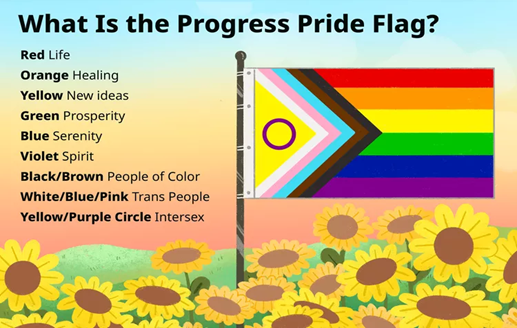
That said, the rainbow flag is evolving. There are now dissent pins, more inclusive pins and flags. There are over fifty different pride flags available. Surely there is something for everyone.

!

 That people argue over what pride flag to fly and what each pride flag means misses the point entirely. The message is one of radical welcome in the name of Christ. The meaning is one of unconditional love and safety for all people. Different groups name the stripes different things. People disagree about what flag to fly and what meaning each stripe should have. Leave it to a bunch of church people to take something that is meant to represent unity, and pick it apart until it has lost all meaning. Leave it to a bunch of church people to find something wrong with every symbol because it doesn’t represent their particular hobby horse. PICK A FLAG AND FLY IT WITH FAITH AND PRIDE.

Oh, the Places You’ll Go

Today is the forty-first anniversary of my ordination. On this June day, I stood in front of 300 or so people, quaked out my vows, felt the hands of my new colleagues on my head and shoulders as I took on the office of ministry. There is nothing special about forty-one years, but every year on this day I reflect on this weird and wild ride that is a life in ministry. It’s a bit like Dr. Seuss…”Oh the Places You’ll Go.” Every year different things come to the fore. Here are this year’s reflections.

I was ordained six weeks before my twenty-fifth birthday. I should have had “clueless” tattooed across my forehead. At some level I knew that I didn’t know nearly enough to launch me into this life, but I blundered forward as best I could.  That I didn’t screw up worse than I did is testimony to grace and the power of the Holy Spirit. And though I know a lot more now than I did then, I still have moments of cluelessness.

I have spent almost fifty years in service to the church. I was ordained to the ministry of word and sacrament and the office of pastor and teacher. This continues to shape my life. I believe in the power of the gospel to transform just about anything that needs to be transformed. That said; the church is a helluva disappointment in many ways. I have moments when I wonder if my service to the institution has been in vain. It is such a screwed up mess. 

I have seen churches wrenched apart by conflict that goes on for generations, an ecclesiastical version of the Hatfield’s and McCoy’s. I have seen the worst of what church people can be. I have seen clergy violate the trust of their office and leave a mile wide path of destruction in their selfish and broken wakes. I have seen churches mired in “the way we’ve always done it” to the point where they choke the life out of what’s left of their living history. Still, it’s what we have (for better or worse) for the ministry of the gospel.

Still, I believe in the life giving, life affirming radical love that is the heart of the gospel. It’s just that I am so disappointed that the church is such a miserable failure at living that out. Now the unofficial keeper of the social status quo, the church has forsaken its role as a radical agent of transformative love and justice making change. It’s enough to make this preacher wring her hands.

Yet, I still stand up every Sunday and preach from the center of my being, because it is what I am called to do. I want to believe it makes a difference but sometimes it is hard to tell. As Scripture reminds us, “God gives the increase.” It’s not about me.

Still, it’s not all gloom and doom. I have seen the church rise to the occasion of local need, global struggle and desperate pain. I have witnessed the healing power of community to reach to the heart of human brokenness and bring hope. I have felt the movement of the spirit when the word comes alive in the preaching and the listening energy is enough to blow me out the back of the chancel. I have witnessed individuals come alive in their faith and be “born again.”

Still, I believe in the ministry of word and sacrament. I believe in the value of gathering at the table to be nourished by the gifts of grape and grain and standing at the baptismal font to bear witness to the promises made with water.

Still, I believe the church has the potential to be transformed, if it can just get out of its own way. If the church can worship God more than it worships its building, it may have a chance. If the church can be the radical life giving community that Jesus intended and intends it to be, there may be hope for the institution. If the church can grow enough in grace and faith to embody a PART of what is called for as the new community in Christ, there may be hope. I have no vested interest in whether the church in its current incarnation survives. Sometimes I think the church should be like a phoenix and rise up out of the ashes of the past into something new and exciting. But the fire has to come first.

I’ll get the matches.

Why We Need Pride Month

A good reason to celebrate Pride Month is that it makes the religious fundamentalists and social conservatives uncomfortable. Spewing their hatred and judgment, they try to out-shout the out and proud people who march in parades…and they fail. It’s a beautiful thing.

The best reason to celebrate Pride Month is because it is all about hope. It is a witness to LGBTQ persons, especially youth who are fed hatred and bigotry instead of love and acceptance. Consider these chilling facts:

  • Suicide is the second leading cause of death among young people aged 10-24 (Hedegaard, Curtin, and Warner, 2018)—and lesbian, gay, bisexual, transgender, queer and questioning youth are at significantly increased risk.
  • LGBTQ youth are more than four times as likely to attempt suicide than their peers (Johns et al., 2019; Johns et al. 2020).
  • The Trevor Project estimates that more than 1.8 million LGBTQ youth (13-24) seriously consider suicide each year in the US—and at least one attempts suicide every 45 seconds.
  • The Trevor Project’s 2022 National Survey on LGBTQ youth Mental Health found that 45% of LGBTQ youth seriously considered attempting suicide in the past year, including more than half of transgender and nonbinary youth.
  • Data show that bisexual youth report higher rates of depressed mood, bullying, sexual assault and physical harm.
  • LGBTQ youth of color reported higher rates of attempting suicide than their white peers in the last year (12% white youth, 21% of Native/Indigenous youth, 20% of Middle Eastern/Northern African youth, 19% of black youth, 17% of multiracial youth, 16% of Latinx youth, and 12% of Asian/Pacific Islander youth).
  • Black transgender and nonbinary youth report disproportionate rates of suicide risk—with 59% seriously considering suicide and more than 1 in 4 (26) attempting suicide in the last year.

These statistics are from the Trevor Project website. The Trevor Project provides crisis services, advocacy, research public education, and TrevorSpace (a safe international community)

If this has not captured your attention, consider this. Much of what is represented in these statistics is wrapped up in a distorted theology of who God is and what God is about. LGBTQ youth and adults are barraged by the media with messages that God hates them, they are condemned to hell, they must repent, and the like. Every day children are cast out of their homes because their parents have internalized a message of hate about LGBTQ individuals. Research shows that LGBTQ are 120% more likely to experience homelessness and that up to 40% of homeless youth are LGBTQ.

To all the Open and Affirming, Welcoming and Affirming, Reconciling Congregations and faithful allies of the LGBTQ community…it takes more than a rainbow flag flying over the front door to get the message of God’s love across to those who have been beaten over the head with a bible by people trying to pray the gay away.

Being a gay friendly community asks something of us. It requires risk. The vast majority of Open and Affirming congregations I encounter in the UCC proudly fly their rainbow flags and proclaim that all are welcome. Their hearts are in the right place, and I celebrate the steps they have taken to be an inclusive community. More, however, is needed.

It takes a tremendous amount of courage for someone who has been traumatized by religion to walk in the door of a church. I don’t care how many rainbow flags festoon the building. I have heard too many stories of members of the LGBTQ community visiting an “open” church only to have no one talk to them, give them anything but a perfunctory welcome, and perhaps stare at their non-conforming attire. Of course we do that with straight people too, so it’s nothing new. But the damage done to someone who has mustered all their courage to walk in the door  is devastating.

What is most tragic, though, is that the heart of the message is never delivered or received. That message is the radical, inclusive, all embracing, joyous love of God who celebrates each and every person just as they are. What is never communicated is that they are truly welcome because this God we worship throws the door open wide to all who hunger and seek, and to all who need healing. The very heart of God is opened with the front door of the church to embrace everyone who walks in the door. The God we worship is a place where one can “unlearn” the hateful, distorted theology they learned that judged and rejected them.

We need Pride Month and we need people of faith to march in gay parades with signs that advertise their church. Straight people need to show they are allies to the gay community. Newspaper editorials and articles are needed to show a loving Christianity that is trying to drown out the voices of hate that are thinly veiled in a distorted view of what faith.

If you’re going to hang a rainbow flag, be prepared to live a rainbow life. Otherwise, don’t bother. The damage you reinforce will be even harder to unlearn.